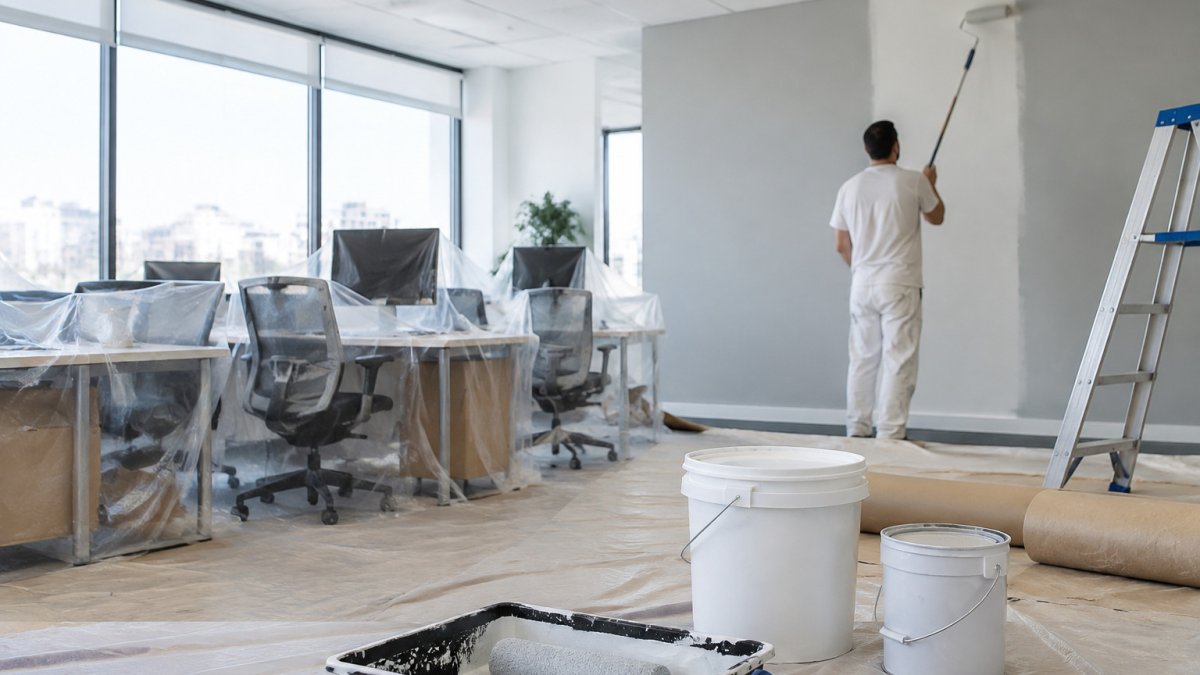
Last Updated: November 23, 2026
Quick Summary
Office painting typically takes one day for a single private office and five to eight days for a large 5,000 sq ft office, assuming average condition and two coats. Elapsed time includes prep, drying and recoat windows, not just labor hours. Phased work in an occupied office can stretch a five-to-eight-day job to two to three weeks.
- A single private office of 400-500 sq ft takes 6-8 labor hours and one day elapsed.
- Preparation and moving furniture takes one to two hours for a single office and half a day for an open floor.
- Most interior wall paints need several hours before a recoat, and the can label is the authority.
- A 12 by 12 foot office with 9 foot ceilings needs about two gallons for two coats.
- Phasing a 5,000 sq ft floor into three zones often stretches the job to two to three weeks.
Table of Contents
- How to Estimate Office Painting Time by Square Footage
- Step-by-Step Breakdown of the Painting Process
- Commercial Office Painting Timeline: What to Expect
- How Long to Paint a Room with 2 Coats
- How Long Does It Take to Paint a Room After Prep?
- Using a Room Painting Time Calculator
- Get a Free Quote for Your Office Painting Project
- Frequently Asked Questions
How to Estimate Office Painting Time by Square Footage
Most office managers ask how long does it take to paint an office and expect a single number.
Office painting time is the total calendar time from the moment furniture moves to the moment the last drop cloth comes up. That includes drying time between coats, not just hours with a brush in hand.
Larger open-plan spaces scale with wall area, ceiling height, and furniture moves.
Two numbers matter, and mixing them up is the most common planning mistake:
- Labor hours are what the crew actually works. These scale with wall area and surface condition.
- Elapsed time is what lands on your calendar. This includes drying and recoat windows, which do not shrink no matter how many painters you add.
Time Estimate Table for Common Office Sizes
| Office Space | Wall Area (approx.) | Crew Size | Labor Hours | Elapsed Time |
|---|---|---|---|---|
| Single private office | 400-500 sq ft | 2 painters | 6-8 | 1 day |
| Small suite, 3-4 rooms | 1,200-1,500 sq ft | 2-3 painters | 16-24 | 2-3 days |
| Open-plan floor, 2,000 sq ft | 2,500-3,000 sq ft | 3-4 painters | 30-40 | 3-5 days |
| Large office, 5,000 sq ft | 6,000-7,000 sq ft | 4-6 painters | 60-80 | 5-8 days |
Wall Area (approx.)
These figures assume average condition and two coats. Add time for heavy patching, tall ceilings, or a fully occupied floor.
Step-by-Step Breakdown of the Painting Process
Every professional job follows the same sequence, and skipping a step always costs more time later.

Preparation and Moving Furniture
Preparation is the step clients underestimate most. Furniture moves to the center of the room or out entirely, and everything left behind gets covered. Painting around desks and filing cabinets feels faster until you are cutting in behind a monitor arm.
For a single office, plan one to two hours of setup. For an open floor, half a day is realistic once you factor in electronics, cables, and anything bolted down.
Cleaning and Repairing Walls
Walls need washing first. Grease, dust, and hand oils stop paint from bonding, which is how you end up with peeling a year later. The crew then fills nail holes, patches cracks, and sands smooth.
If your walls need more than patching, drywall installation and repair covers taping and skim coating for a paint-ready finish. Old wallpaper has to come off first, and wallpaper removal handles the removal and wall repair that follows.
This stage is where timelines stretch. A wall in good shape takes an hour; one with water damage or decades of patches can take most of a day.
Taping and Protecting Floors and Furnishings
Painter’s tape goes on trim, window frames, and outlets. Drop cloths cover floors and remaining furniture.
Watch out: cheap tape left on too long can pull fresh paint off trim when it comes away. Use quality tape and remove it while the paint is still slightly soft.
Applying Coats and Drying Time
Paint application is typically the fastest part of the job. Drying is what you cannot rush. Most interior wall paints need several hours before a recoat, and the can label is the authority.
Expect the full process to run like this:
- Move and cover furniture: 1-2 hours
- Clean and repair walls: 1-6 hours
- Tape and protect surfaces: 30-60 minutes per room
- Cut in edges and roll first coat: 2-4 hours
- Wait for recoat time: 4 or more hours
- Apply second coat: 2-3 hours
- Inspect, touch up, and clean up: 1-2 hours
For the full service that handles this sequence, see our interior painting work.
Commercial Office Painting Timeline: What to Expect
A commercial office painting timeline runs longer than a residential one for reasons unrelated to paint: more wall area per room, more furniture, more doors and trim, and more people who need to keep working. The biggest driver of elapsed time is how the space is occupied and phased around.
Layout Drives the Calendar More Than Square Footage
Two offices with the same square footage can take very different amounts of time depending on layout. A 2,000 square foot open-plan floor is mostly continuous wall and ceiling, so a crew can roll it in long passes. The same footprint broken into eight private offices, a conference room, and a corridor has far more cut-in, doors, frames, trim, and furniture, often 30 to 50 percent more labor.
A practical way to think about it:
- Private offices: high labor per square foot because of doors, frames, trim, and furniture; each room is a separate setup and cleanup.
- Open-plan floors: lower labor per square foot, but ceiling height and furniture density (workstations, cable trays, monitors) add protection and move time.
- Conference rooms: often the slowest rooms per square foot because of AV equipment, glass walls, and accent walls that need careful cut-in.
Phased Work in an Occupied Office
Most commercial projects are phased by wing, floor, or department so staff relocate rather than stop.
After-hours and weekend work is another lever. Evening and weekend crews avoid displacing employees but carry a scheduling premium and can slow drying-dependent steps because the building may be closed and unventilated overnight.
Watch out: promising a return-to-service date before confirming recoat windows and cure time is the most common cause of a missed move-back.
Return-to-Service Time
The calendar does not end when the last roller stops. Plan for:
- Drying and ventilation: several hours after the final coat before the room is comfortable to occupy, longer in humid conditions or with limited airflow.
- Furniture move-back: one to two hours per room for a small office, longer for open floors with electronics and cable management.
- Touch-up and inspection: a walkthrough with the facility manager to catch scuffs, missed cut-in, and damaged trim before furniture returns.
Commercial Surfaces That Add Time
Commercial surfaces add their own time. High-traffic corridors often need a harder finish, meaning an extra coat or longer recoat window. Commercial drywall frequently needs more patching than residential walls due to past tenant improvements, anchor holes, and moved partitions. Doors, frames, and metal trim may need a bonding primer and a different recoat schedule.
For planning a commercial project from start to finish, commercial painting outlines the scope and scheduling options.
How Long to Paint a Room with 2 Coats
The answer to how long to paint a room with 2 coats is one to two days for a standard private office, including prep and drying. The two coats themselves take only a few hours of actual work. In an office, “a room” usually means more than four walls, ceilings, trim, doors, and frames are often in scope, each adding its own recoat cycle.
The second coat is where people get impatient. Applying it too early traps solvent and causes blistering or poor adhesion. Follow the manufacturer’s recoat time on the can, and add extra time in humid weather or with limited overnight airflow.
A quick comparison for a standard 12 by 12 foot office with 9 foot ceilings:
- First coat: 2-3 hours for cut-in and roll on walls
- Recoat wait: 4 or more hours, per the label
- Second coat: 2-3 hours
One coat only works when refreshing the same color over a sound surface. Changing color, especially light to dark, almost always needs two.
How Office Scope Changes the Two-Coat Calendar
A private office with four walls and a ceiling is not the same as an open-plan floor with workstations. The two-coat calendar stretches for reasons that are specific to commercial spaces:
- Ceilings: often painted in offices but skipped in homes. A ceiling adds a full coat cycle and requires protection of everything below.
- Trim and doors: commercial doors and metal frames may need a bonding primer and a different recoat schedule than wall paint, which can add a day to a room.
- High-traffic areas: corridors and reception areas may need a harder finish or an extra coat, adding another recoat window.
A common pattern in occupied offices is to paint one coat before the weekend and the second on Monday, so the recoat window passes while the space is empty.
Watch out: stacking the second coat on the same day as the first to save a return trip is the most common cause of blistering and poor adhesion in office repaints, especially over patched drywall.
If you are hiring out, ask the estimator to separate wall time from ceiling and trim time. A quote that lumps them together hides where the days go.
How Long Does It Take to Paint a Room After Prep?
Once prep is finished, how long does it take to paint a room after prep? Plan on one full day for two coats and drying, or half a day if the room is small and the crew is efficient.
Prep is the variable, not the painting. A room that is already clean, patched, and taped moves fast; one straight out of a renovation does not.
Here is the practical split:
- Prep complete, walls sound: 4-6 hours of work plus drying
- Prep complete, walls need spot patching: add 1-2 hours
- Prep complete, ceiling and trim included: add 3-4 hours
Using a Room Painting Time Calculator
A room painting time calculator gives you a starting estimate, not a schedule. The math is simple: measure wall area, divide by coverage per gallon, multiply by coats, then add prep and drying.
Here is the formula we use:
- Measure the length and width of the room
- Multiply by ceiling height to get wall area
- Subtract doors and windows, about 20 square feet each
- Divide by the coverage printed on the paint can, typically 350 to 400 square feet per gallon
- Multiply by the number of coats
- Add prep hours and drying time
Run it for a 12 by 12 foot office with 9 foot ceilings. Wall area is about 432 square feet. Subtract one door and one window and you have roughly 392 square feet. At two coats, that is about two gallons. Labor lands near 6 to 8 hours, and elapsed time is one day.
The calculator cannot see condition. Cracked plaster, water stains, or a dozen old anchor holes all add hours the formula misses.
Get a Free Quote for Your Office Painting Project
Estimating gets you close. Our painters in West Hartford measure the actual walls, check surface condition, and give you a written timeline before anyone picks up a roller.
We aim to build schedules around your business hours. We offer satisfaction guaranteed service and customized scope for your space.
Get started with Nunes Painting for a free quote on your office painting project.
Square footage gives you a ballpark, but condition and scheduling decide the real date. Send us your floor plan and we will turn it into a firm estimate.
Frequently Asked Questions
How much do painters charge to paint an office?
Pricing for office painting depends on square footage, surface condition, number of coats, and whether the work happens after hours. Most companies provide a free quote after assessing the space. For accurate pricing tailored to your office, contact Nunes Painting for a free quote.
Is 2 days enough for paint to dry before using the office?
Most interior paints are dry to the touch within 4-6 hours, but they need 24-48 hours to cure fully. Light foot traffic is usually fine after 24 hours, but avoid moving heavy furniture or cleaning walls for at least 48 hours. Check the manufacturer’s recommendations for the specific product used.
How many rooms can a professional painter paint in an 8-hour day?
Larger rooms or those needing extensive repairs will take longer than a standard room. Crew size, drying time between coats, and room complexity all affect daily output.
Can an office be painted in one day?
A small office (under 500 square feet) with minimal furniture and good wall condition can often be painted in one day by a professional crew. Larger offices or those requiring repairs, multiple coats, or special finishes will take longer. Scheduling during off-hours can help minimize business disruption.

Leave a Reply